"I wasn't stuck chasing the target on the last day."
That sentence is very rare in Black Friday, because most people arrive at 29 November still on 40% and start doing rushed things.
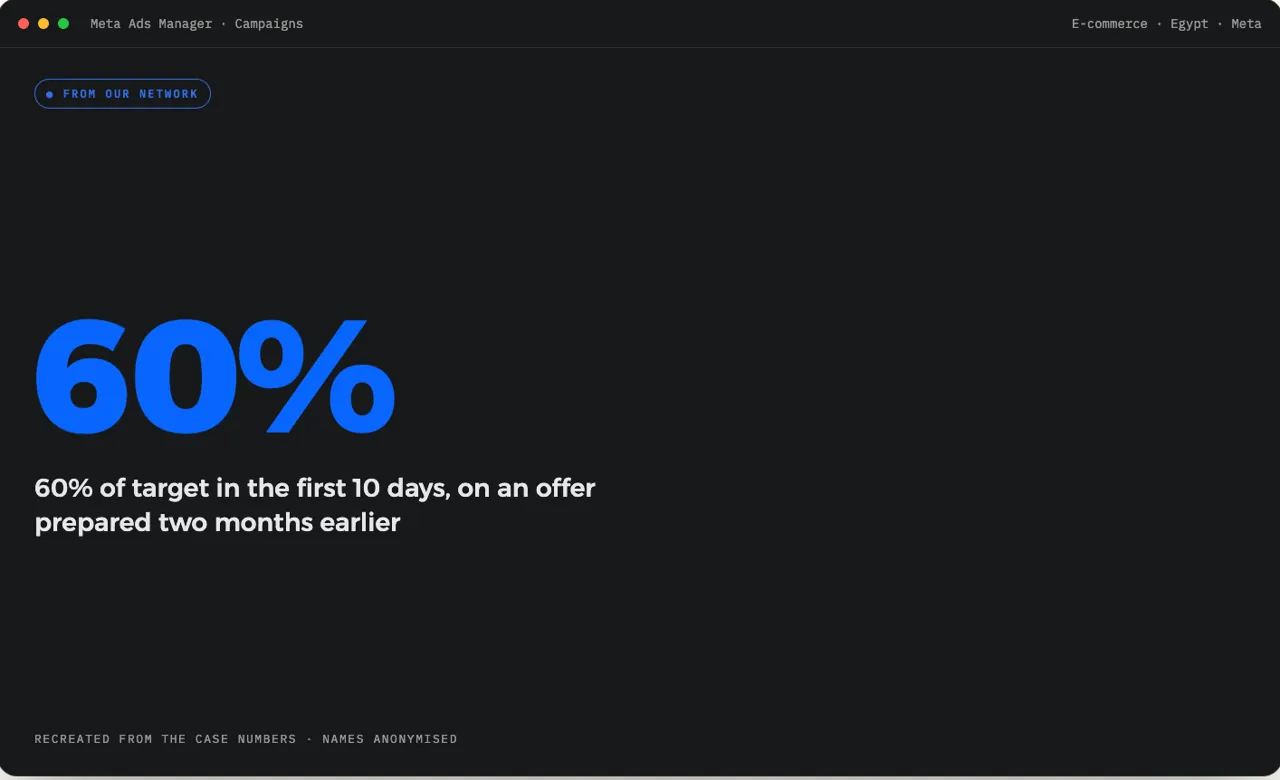
This was his first Black Friday, and 60% of target was hit in the first ten days.
He named three things that got him there early.
First, a good offer prepared more than two months in advance. Not an offer decided the night before Black Friday. Two months of preparation: what gets discounted, by how much, for whom, and until when.
Second, an excellent and well-known product. People already knew it and were waiting for the opportunity. Black Friday isn't the time to introduce a new product, it's the harvest for one people already love. If the product is unknown, you're attempting two jobs at once during the busiest week of the year.
Third, simple presence without complication. In his words: all you need is to show up well and tell people there's an offer for a short time, without any complexity in the ads. Not fifteen campaigns and forty audiences. One clear message: there's an offer, and it's ending.
The only published number is the 60% in ten days, and we won't add to it.
But why does that timing matter so much?
Because whoever reaches 60% early can spend the remaining twenty days improving calmly, raising budget on what works, closing what doesn't, and reading the numbers with a clear head.
Whoever is at 40% on 25 November does the opposite: bigger discount, bigger budget, higher cost. They may still reach the target, but with margin eaten and a customer who has learned to wait for the discount.
Both can close on the same number. They are not the same month at all.
With the offer, the product and the message ready two months ahead, the ads become the easiest part of the season.
The lesson
The season starts two months earlier