A Meta account that looks stable. Decent ROAS, steady spend.
And in the background, sales falling and the share of returning customers rising.
Those two things happen together often, and the account keeps looking healthy until it's late.
The number that exposes it is called net new reach.
Ordinary reach tells you how many people you reached. It doesn't tell you whether they're new people or the same people seeing you again.
That's the whole difference.
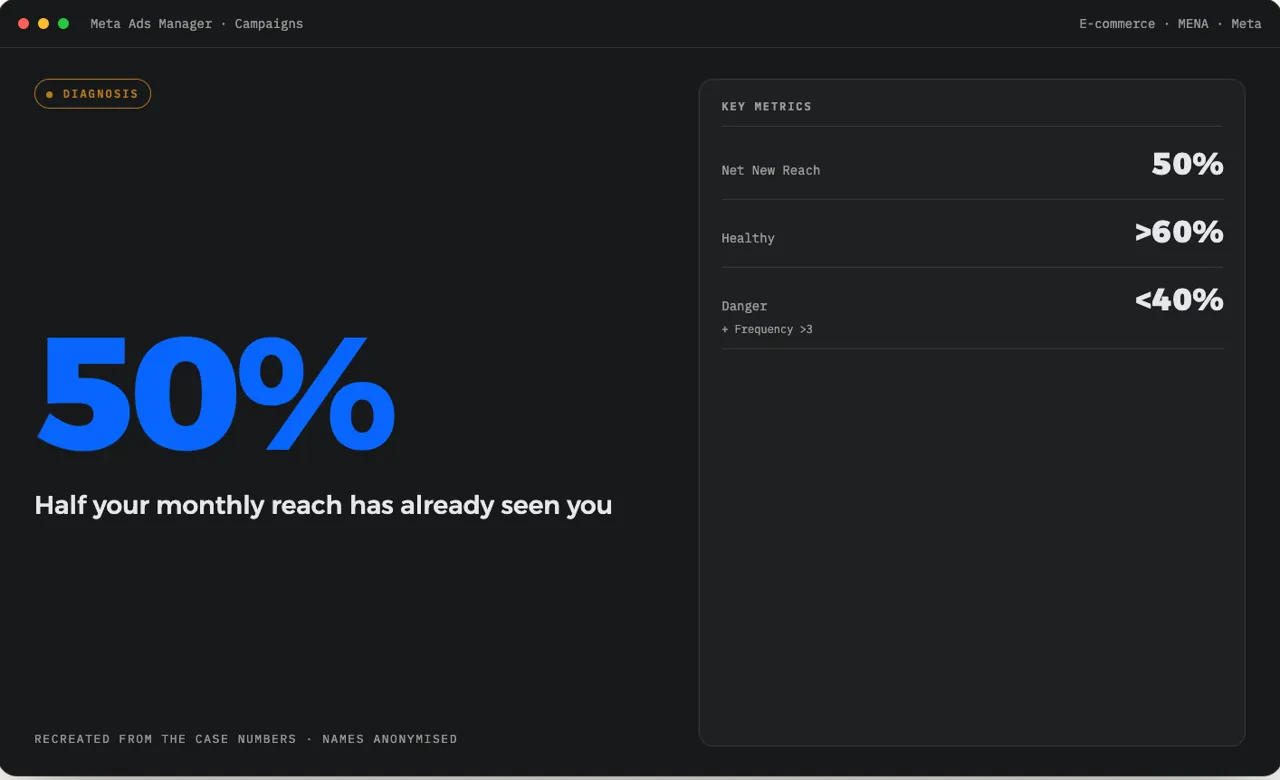
How it's calculated: July reach 100,000. August reach 90,000. Combined reach across both periods 145,000. So August net new reach is 145 minus 100, which is 45,000. As a percentage, 45 divided by 90, which is 50%.
Half the people who saw you in August had already seen you in July.
The rule that was set: above 60% means the account is expanding well. Between 40% and 60% means watch it. Below 40% with frequency above 3 is danger.
And if CPP is rising alongside it, returning customer rate is rising, and new customers are falling, the problem isn't the bid or the structure. The account has stopped bringing in new people and is consuming itself.
Here's the trap that fools most people. A rising returning-customer rate feels good. It looks like loyalty. But if it rises while sales stay flat or fall, it isn't loyalty at all. You're living off the old list and watching it run out.
What was done once the number surfaced: new angles and new creative, because as long as you address the same people with the same angles Meta will circle the same loop. Partnership ads to reach a new segment quickly. Excluding all previous buyers and reducing retargeting spend. Reviewing the offer, asking whether it suits someone seeing you for the first time or someone who already knows you. And adding a platform like Snapchat or TikTok so new people don't come from a single source.
A rising returning-customer rate feels good. But if it rises while sales stay flat or fall, that isn't loyalty. That's living off the old list.
The lesson
An account can look healthy while consuming itself