System build
B2B Lead-Gen: Lead-Source Attribution + CRM Analysis + ICP Definition
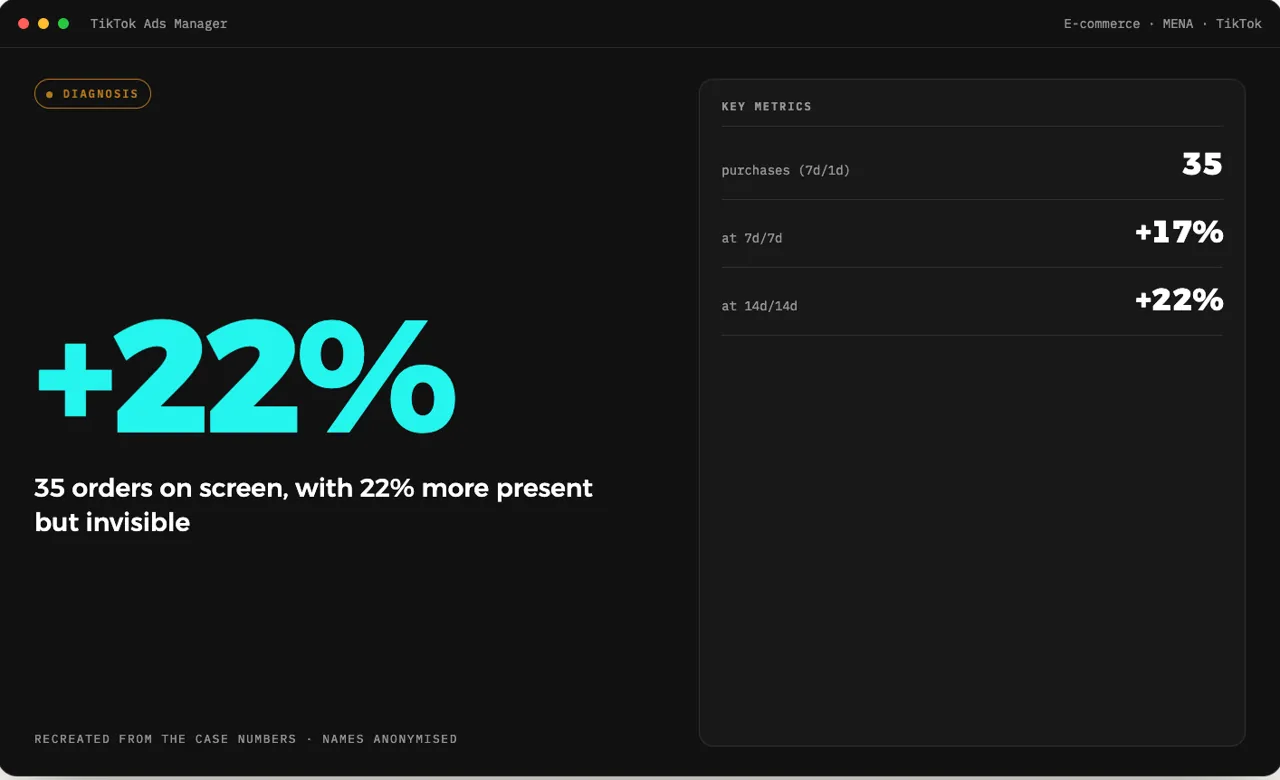
35 orders on screen, with 22% more present but invisible
uplift that was present but hidden from reporting
A TikTok ad group produced 35 purchases, on default attribution: seven-day click, one-day view.
Perfectly ordinary. A number like that gets judged in a second.
But TikTok now does something. When you change the window, it calculates a forecast uplift, the expected increase had you chosen a different window.
The result on exactly the same ad with the same budget: 7d click / 7d view showed a 17% increase in purchases. 14d click / 14d view showed 22%.
So out of 35 orders, roughly 43 had actually been produced by that ad. The narrow window simply couldn't see them.
What does that mean practically?
When you judge an ad as weak and close it, you may be closing an ad that works. Because your customer takes two weeks to decide, not one day.
That happens constantly on higher-priced products, in cosmetics, and in anything people compare before buying.
Which means you aren't measuring the ad's performance. You're measuring the ad's performance inside a period you chose.
But be careful, there's an opposite risk too.
A wider window can credit you with orders that would have happened anyway without the ad. So the goal isn't widening the window until the numbers look nicer.
The right approach is choosing a window that matches your customer's actual decision cycle, locking it, and comparing everything on the same measure.
Because any change to the window afterwards makes every comparison you made before it wrong.
Real ROAS is higher than what's on screen, but not because the ad improved. Because you looked through a wider window.
Lock the window before reading the number
Book a growth audit. You get a written plan within 48 hours.
We start with a 360° audit
Expect your audit within 48 hours. Want it faster? Message us on WhatsApp.