System build
Clinic Ops: WhatsApp Cloud Integration + Staff Routing + Patient Attribution + Unified Dashboard
0.30% CVR on a high-ticket AOV
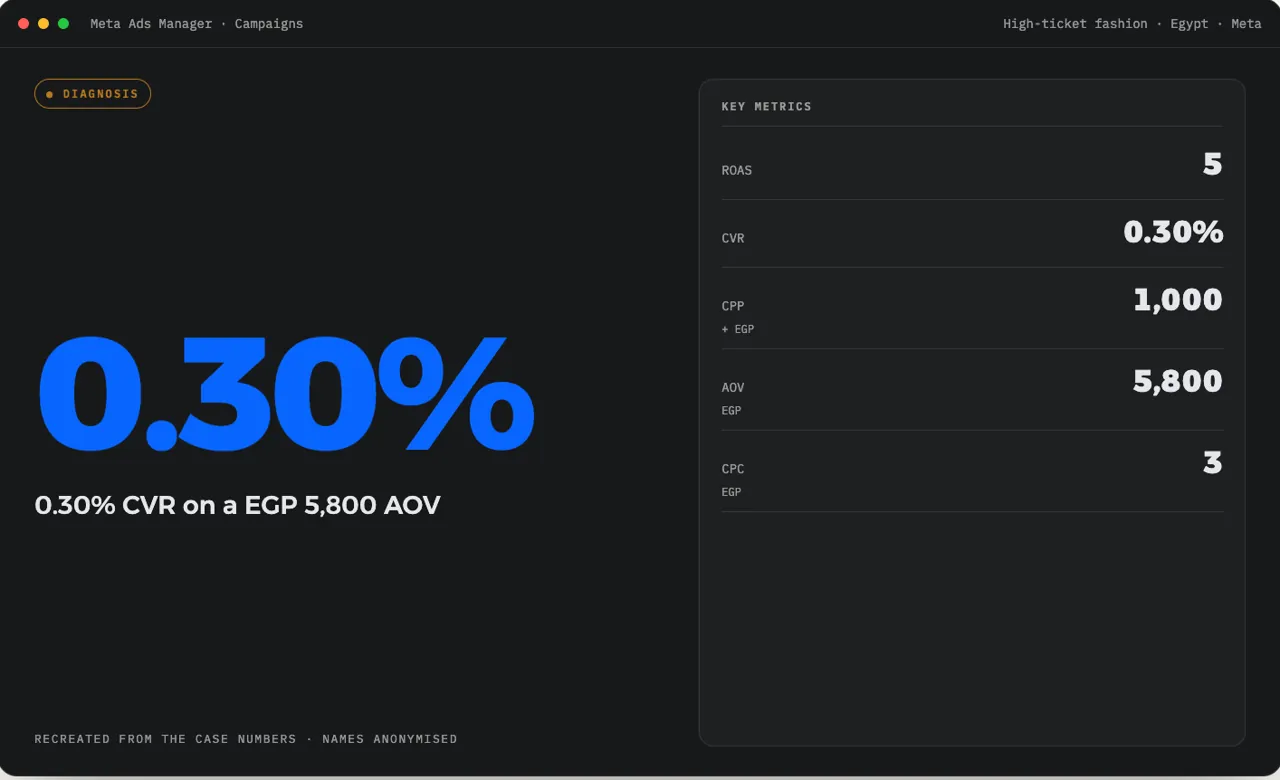
conversion rate found in the audit
"This is the best UI/UX possible."
That's the e-commerce manager, refusing any change to the site.
The numbers the account was handed over with: ROAS 5. Conversion rate 0.30%.
High-ticket fashion e-commerce in Egypt. A large share of the products are formalwear, and people prefer buying those in store because of sizing.
So what do these numbers say if you actually calculate them?
A very low CPC against a high-ticket AOV is very cheap traffic. The ad brings people easily and without effort.
But only 0.3% of them buy. One order per 333 visits. A low CPC times 333 clicks per order matches the CPP exactly.
So the problem isn't bringing people in. It's what happens between the click and the purchase.
And ROAS 5 isn't bad on paper. But on formalwear with limited margin and size-driven returns, it's probably barely breaking even.
Where exactly is the customer stalling?
Formalwear at this price requires three certainties before payment: certainty about the size, certainty about the fabric, and certainty they can return it.
If the site doesn't answer all three on the product page, they'll go and get certain in the store. Which is precisely what's happening: people prefer buying from the branch.
So the site isn't the best UX. It's a UX not designed for a high-ticket price point. It may look excellent, and that isn't the same thing.
The manager won't give you room? Don't argue about UX. Argue with numbers.
Run a test on a single product page: a size guide in centimetres, a fabric video, and a clear exchange policy above the buy button. Set add-to-cart as an event and compare ATC rate between the old page and the new one, so a number does the convincing rather than an opinion. The 99.7% who arrived and didn't buy are your most valuable audience, so retarget them with "book a fitting at the branch" or "order and try at home," not with a discount. And if the branch is what actually closes, let the ad sell a branch visit and be measured on it, rather than selling an online order that won't happen.
Don't argue about UX. Argue with numbers. Change one product page, compare it, and let the number do the convincing.
UX is judged against the price point, not the look
Book a growth audit. You get a written plan within 48 hours.
We start with a 360° audit
Expect your audit within 48 hours. Want it faster? Message us on WhatsApp.