System build
DTC Fashion: Hierarchical Media System + Inventory Reconciliation + CRO Implementation
CVR under 1% with both platforms, 2% with Meta alone
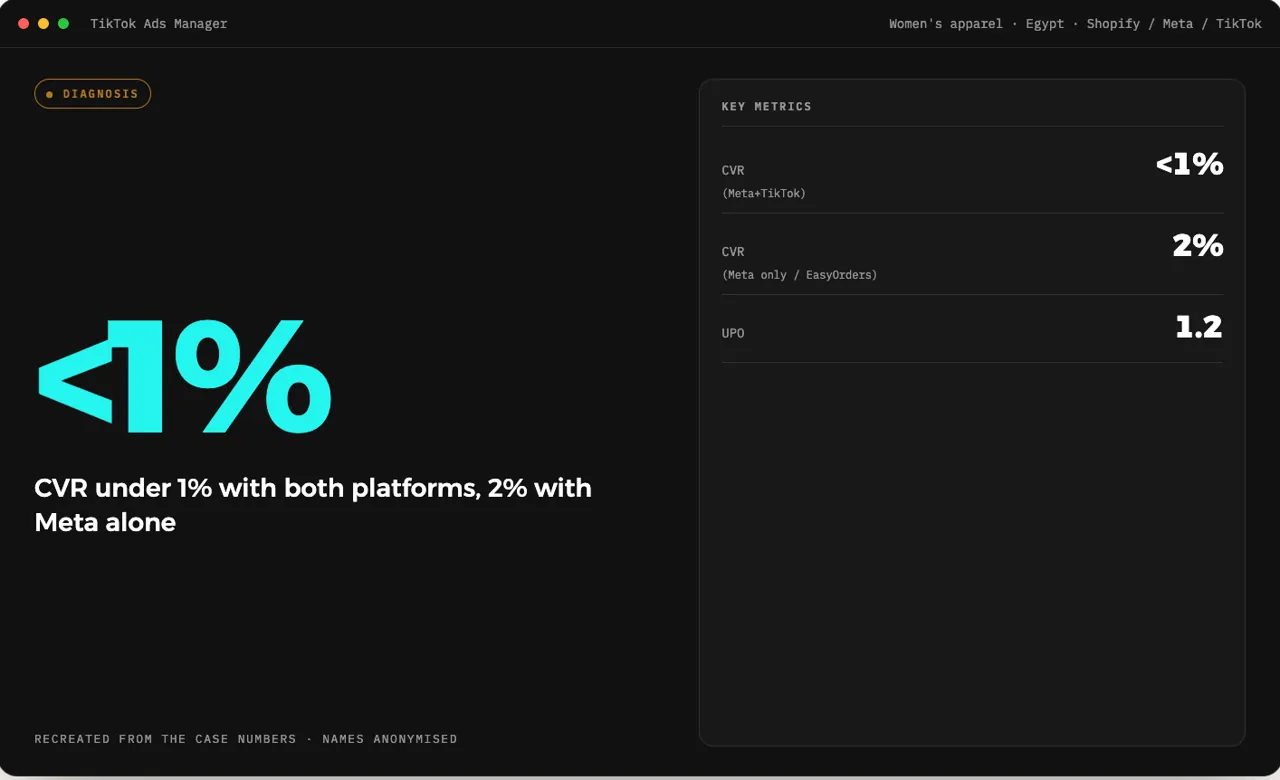
conversion rate across both platforms, 2% on Meta alone
Conversion rate below 1% when TikTok and Meta run together. It was 2% on EasyOrders. And on Meta-only days it returns to 2%.
A women's clothing brand in Egypt. It had run EasyOrders and Shopify in parallel, and once the numbers settled it moved fully to Shopify in October. After the migration, conversion halved. And UPO, units per order, sits at 1.2 and won't move.
He tried everything: two pieces at 10% off, three at 15% off, a discount across all prices, free shipping, a new theme, fixing the speed problem, and a COD popup checkout resembling EasyOrders.
And still, below 1%.
The natural conclusion is that Shopify is the problem.
But look at a sentence he passed over quickly while explaining: "on the days I run Meta only, conversion is 2%, but there's no volume."
That sentence solves the whole case.
The conversion rate isn't a Shopify problem at all. Conversion falls when TikTok enters.
TikTok brings a lot of cheap traffic with far lower purchase intent than Meta in Egyptian fashion. Blend the two into one number and the number falls while you believe the site is broken.
That also explains why none of the offers made a difference. An offer improves a decision for someone with intent. It doesn't create intent in someone who arrived from a video they were watching with no intention of buying anything.
And UPO at 1.2 is exactly the same story. Someone buying a single item while hesitating won't buy three for 15% off.
What he was told:
Separate CVR by platform in Shopify analytics rather than reading one number. TikTok alone will be 0.3% to 0.5% and Meta 2%. Judge TikTok on CPA rather than CVR, and if its CPA is more than 30% above Meta's, close it or convert it to retargeting only. Get volume from Meta through new creative and wider audiences, not through another platform. And raise UPO with a ready-made bundle on the product page, a complete set at one price, rather than a quantity discount.
An offer improves a decision for someone with intent. It doesn't create intent in someone who arrived from a video they were watching.
A blended average across platforms hides the problem
Book a growth audit. You get a written plan within 48 hours.
We start with a 360° audit
Expect your audit within 48 hours. Want it faster? Message us on WhatsApp.