Most courses talk about keywords, bidding and headlines. All of them matter. In this account, none of them was the difference.
A Saudi store running Google Ads only, across six months between Q4 2024 and Q3 2025.
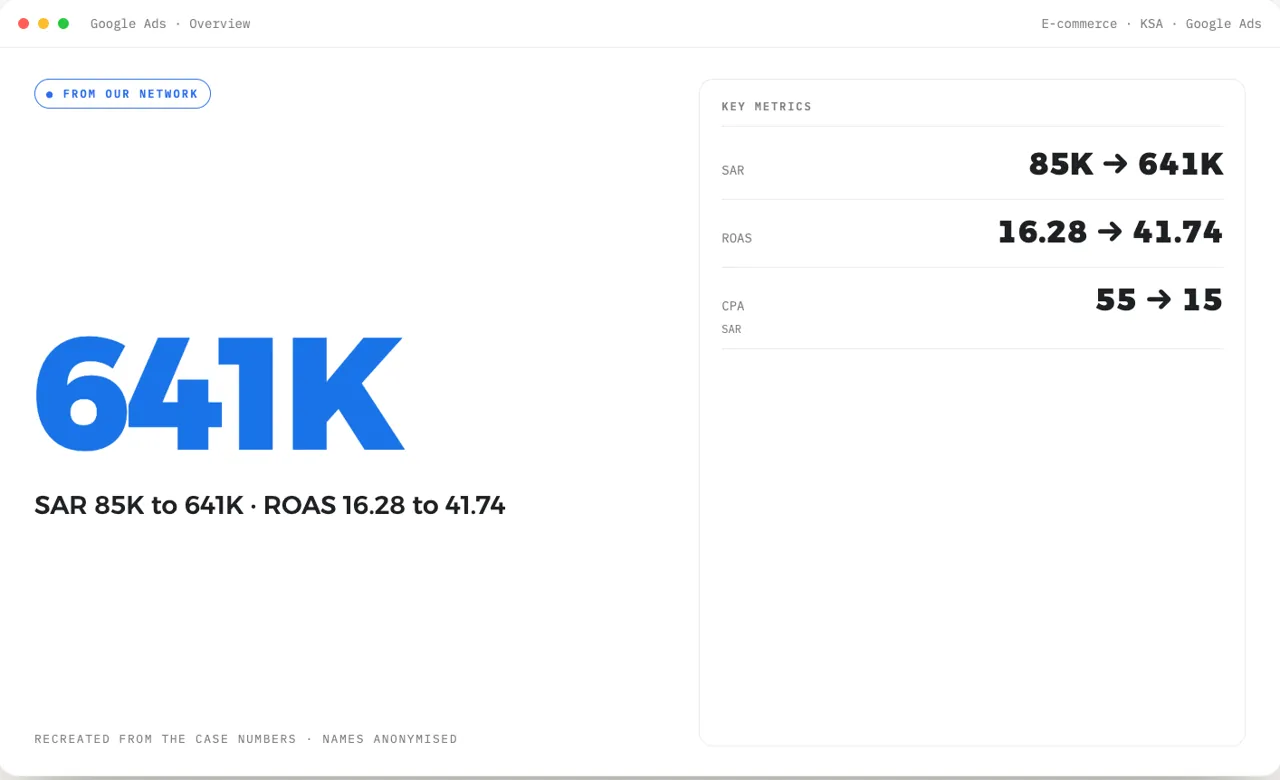
Quarterly sales rose 7.5x. ROAS from 16.28 to 41.74. Spend tripled. Search CPA fell by almost three quarters.
Note the comparison: spend tripled while sales rose 7.5x. That isn't scale, that's a change in efficiency.
The order of work went like this.
First, store CRO and relevancy between the words in the ad and the words on the landing page, the step most people skip. When a searcher finds the exact term they clicked on present in the page, quality score rises and cost falls. That is what cut CPA by almost three quarters, not a bid adjustment.
Second, identifying fast-moving products. Winners were grouped into their own category with a dedicated PMax campaign, scaled 20% on ordinary days and 50% or 100% around paydays and seasons, but always with target ROAS attached. Scaling had written brakes rather than instinct.
Third, and this mattered more than the two above: offer and social proof on social media. A full funnel outside Google, with branch videos, customer reviews and FOMO. That raises awareness and trust, so when the same person is later retargeted through PMax or searches directly, the purchase decision is already close to made.
Alongside it, a daily audit of search terms, negative keywords added every day, and headlines refreshed.
He says it plainly: if Google drops or you want to scale, look at the bigger picture, because most of the time the problem isn't bidding or keywords.
Google rewards a site that matches its ad, and social prepares the customer before they ever search. Together they are the 41.74. Neither one alone is.
The lesson
When Google drops, look at the big picture