"Google doesn't work in Egypt."
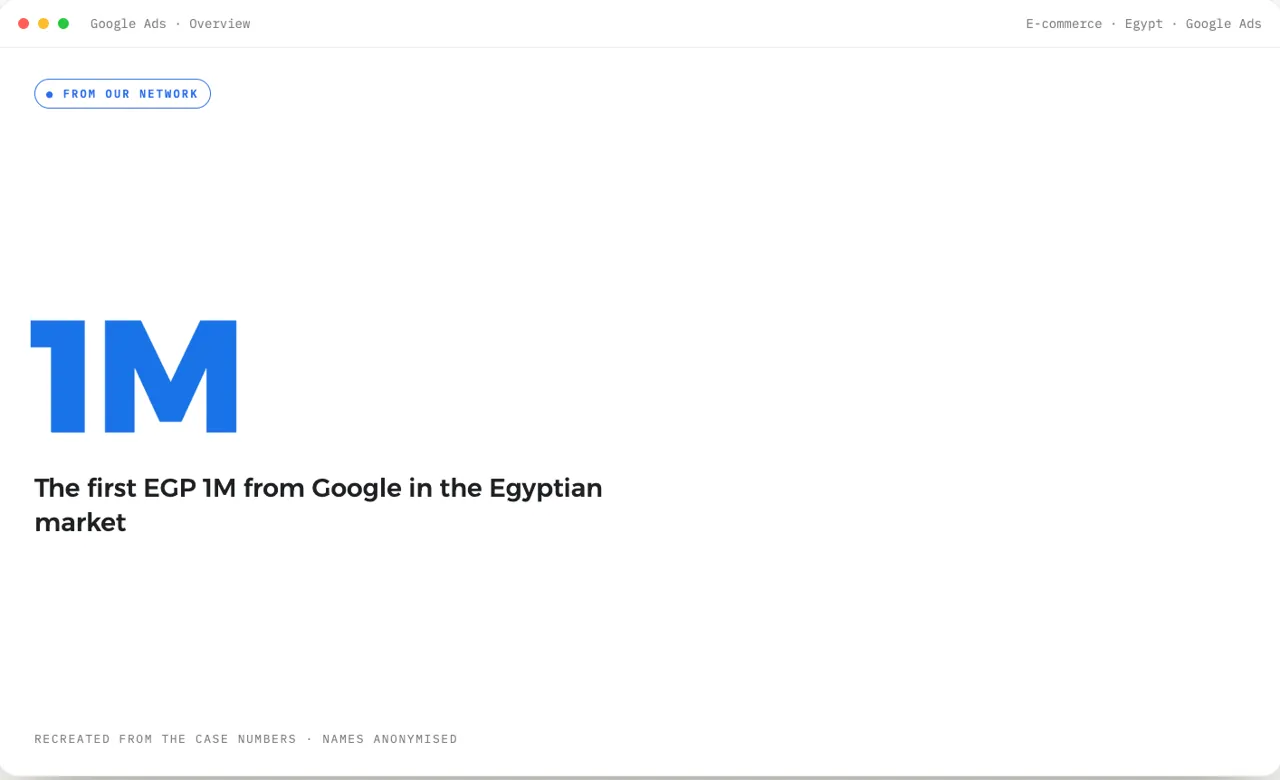
That line gets repeated weekly. And this account's Google channel hit its first big sales milestone in ten days.
Only that one line was published, with no detail on spend, ROAS or campaign types, so we won't invent any.
But the case matters because of the sentence, not the number.
Why do people say it? Because most who tried Google in Egypt tried it exactly like this: a search campaign on generic terms, a landing page that is the homepage, tracking that half works, a tiny budget for a week, and then "it didn't deliver."
That isn't a test of the platform. It's a test of something else entirely.
A result like that in ten days means serious daily sales from Google alone, and that only happens when four things are true.
There has to be demand that already exists, people searching for the product or category by name. This is the part that decides everything: Google doesn't create demand, it captures it. That's why it works in electronics, appliances, furniture and services, and is far weaker for a new product nobody has heard of.
Tracking has to be correct from day one, with conversions recorded properly and at the right value, or Smart Bidding learns the wrong thing, and learns it fast.
There has to be Shopping or Performance Max alongside Search rather than Search alone. In Egyptian e-commerce the Shopping feed is usually what produces volume.
And the page has to finish the job. Someone searching by name has very high intent, and loses it in a second on a slow page or an unclear price.
Another case confirms the same idea from a different angle: a Saudi store whose Google sales rose 7.5x, where the difference again wasn't bidding. It was the site, the offer, and the match between ad and page.
Before any Google campaign, ask how many people search for this product monthly. If the number is small, Google is the wrong platform, which is not the same as Google not working.
The lesson
Google works in Egypt when the basics are right